System and Network Security Lab. (SNSec Lab.)
Division of Artificial Intelligence Engineering, Sookmyung Women's University
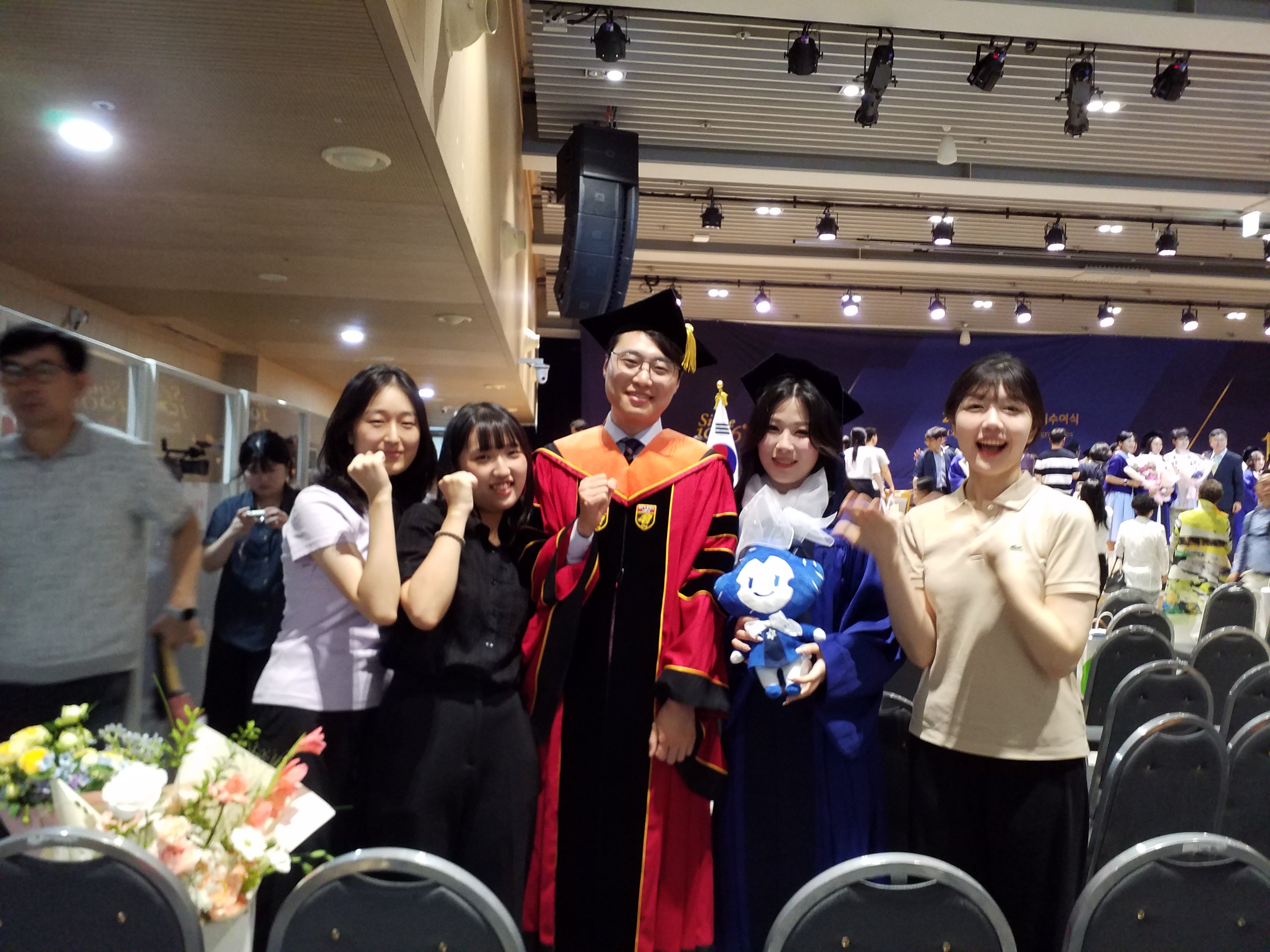
SNSec Lab. members (Aug 21, 2026)
Welcome to SNSec Lab
SNSec Lab. investigates and addresses cybersecurity challenges in Internet service applications through a data-driven approach that utilizes machine learning and deep learning methodologies. Our team analyzes massive live data streams to secure computer systems and networks from evolving threats, leveraging experience with diverse datasets including commercial server-side logs, root DNS servers, mobile payment transactions, and car hacking activities.
We specialize in identifying and explaining intrusions in connected vehicles, notably employing anomaly detection techniques trained solely on benign data.
Key Research Areas
- Trustworthy Network Intrusion Detection: We aim to move beyond simple classification accuracy to build systems that are robust, adaptive, and explainable using Foundation Models.
- Multi-modal Traffic Representation & Pre-training: Integrating payload bytes, packet sequences, and protocol metadata to learn comprehensive traffic representations without information loss.
- Drift Resilience & Efficient Adaptation: Developing unsupervised metrics to detect concept drift in real-time and utilizing parameter-efficient fine-tuning (PEFT) to adapt models to new environments with minimal cost.
- Generative & Causal Reasoning: Applying generative AI to not only detect threats but also explain their causes (causal reasoning) and suggest response scenarios.
-
Automotive Security: We are developing an Explainable Unsupervised IDS for Automotive Ethernet and researching standardized intrusion prevention systems for connected vehicles to offer practical solutions for both industry and academia.
-
Advanced Threat Detection: We are developing DRIFT (Drift-Resilient Invariant-Feature Transformer), an advanced DGA detector that uses a hybrid tokenization strategy and multi-task self-supervised pre-training to maintain robustness against evolving domain generation algorithms.
- AI-driven Proactive Resilience: We engineer autonomous solutions that transform reactive defense into proactive resilience by bridging the gap between deep system telemetry (Linux, Windows, macOS) and multi-modal Foundation Models. Our goal is to automate the real-time situational assessment of live systems and identify potential cybersecurity issues before they escalate. Read more about our research vision here.

Research and collaborations in progress
- Bi-modal Enhanced Explainable IDS for Controller Area Network (with Dr. Hyunjae Kang)
- Explainable IDS for Automotive Ethernet (with Jisoo Kim)
- Meta-learning based few-shot IDS for IoT devices (with the University of Queensland)
- J1939 based IDS for connected vehicles (with Korea University)
news
| Oct 21, 2026 | Jisoo Kim has had her third paper, “Beyond Bot Labels: Retrospective Consequence-Grounded Ranking of Attributed Cache Harm in E-Commerce Logs,” accepted as a regular paper at the 2026 IEEE International Conference on Big Data (IEEE BigData 2026), a conference with an acceptance rate of 19.4%. Rather than labeling e-commerce sessions as bots or humans, the paper ranks them by the cache harm they actually cause real shoppers, charging each shopper’s cache miss to the session that evicted the object and learning to predict this harm from session behavior alone. |
|---|---|
| Oct 17, 2026 | SNSec Lab has been approved for Defense Access in Anthropic’s Cyber Verification Program (CVP), which expands our use of Claude for defensive security research such as vulnerability triage, malware analysis, and incident response. |
| Oct 13, 2026 | My CV has been updated — download the latest version (PDF). |
| Oct 11, 2026 | Jisoo Kim’s paper, “X-SPUR: Explainable Surprisal-Based Protocol-Aware Unsupervised Reasoning for Automotive Ethernet Intrusion Detection,” is now available online in the Early Access area of IEEE Xplore. The article has been accepted for inclusion in a future issue of IEEE Transactions on Industrial Informatics (TII) and can be cited by its DOI, 10.1109/TII.2026.3736030. |
| Oct 10, 2026 | The lab’s sign-in portal, auth.snsec.net, has a new look with the SNSec Lab logo and a hanbok calligraphy background. |
latest posts
| Sep 12, 2026 | SMU Cats |
|---|---|
| Aug 02, 2026 | SNSec Lab in July: Two Weeks on Binaries, and a Summer Dinner |
| Jul 17, 2026 | My LF Sonata Turns Ten |
selected publications
- DRIFT: Drift-Resilient Invariant-Feature Transformer for DGA DetectionIn 56th Annual IEEE/IFIP International Conference on Dependable Systems and Networks (DSN 2026), Jun 2026
- J1939DB-IDS: SAE J1939 Dual-Branch Intrusion Detection System Against Novel AttacksIEEE Transactions on Network and Service Management, 2026
- AERO: Automotive Ethernet Real-Time Observer for Anomaly Detection in In-Vehicle NetworksIEEE Transactions on Industrial Informatics, 2024
- X-CANIDS: Signal-Aware Explainable Intrusion Detection System for Controller Area Network-Based In-Vehicle NetworkIEEE Transactions on Vehicular Technology, 2024